
• Home
  • Blog
  • About Me
  • Contact
Menu

friendscallmep

  • Home
  • Personal Works
  • Blog
  • About Me
  • Contact

P’S BLOG


Subscribe

Sign up with your email address to receive news and updates.

We respect your privacy.

Thank you!

Black History 365 | # 247 Wilson Saoko Manyoma

July 27, 2025

Wilson Manyoma, also known as “Saoko,” was a renowned Colombian salsa singer, widely recognized for his role in the legendary orchestra Fruko y sus Tesos. His unmistakable voice brought classics like El Preso to life, one of the most iconic songs in the history of Colombian salsa. Over the course of his career, Manyoma also worked with other renowned groups including The Latin Brothers and La Sonora Dinamita. In addition, he launched his own musical project, Wilson Manyoma y la Orquesta Saoko, further cementing his influence in the genre. His legacy is defined not only by his music but also by his impact on future generations of salsa musicians. "Manyoma was not just a singer; he was a phenomenon in the salsa world, embodying the spirit and rhythm of Cali's streets," said Martín Cortés, a music critic for Caracol Radio. Manyoma leaves behind a rich discography, peppered with hits like "Los Charcos," "Mi Rio Cali," "Zafra y Molienda," and "El Patillero." These songs not only highlight his musical talent, but also his deep love for his city and its culture. As the salsa community and music lovers worldwide remember Wilson Manyoma, his songs continue to resonate, a lasting testament to his contribution to the world of music. His voice, once a defining sound of Colombian salsa, will forever echo in the hearts of those who knew him and those who were moved by his music. He passed away on the morning of February 20 in his hometown of Cali after a prolonged battle with cancer. Rest in peace.

Tags Black History 365
Comment

Black History 365 | # 246 Queen Mother Moore

July 26, 2025

Audley “Queen Mother” Moore had fond memories of Marcus Garvey, the charismatic Black nationalist leader of the Universal Negro Improvement Association (UNIA), the largest and most influential global Black nationalist movement of the twentieth century. Recounting a story in a 1973 interview with the Black Scholar, Moore vividly describes the first time she heard Garvey speak in New Orleans, Louisiana in 1920: “We heard that Garvey was coming to New Orleans, but the police would not allow him to speak. Garvey came and they arrested him. The people raised so much sand until they had to let him out the next night.” In the aftermath of Marcus Garvey’s deportation, Moore turned to the Communist Party (CP), viewing it as a viable political alternative, and as a space in which to continue the political work she began in the Garvey movement. In 1950, she left the CP, claiming that members of the party failed to address racism and sexism. She also criticized the party for withdrawing their support of self-determination. While the actual circumstances concerning Moore’s decision to leave the CP are unclear, it is likely that her decision was motivated by the increasing government repression during this period. From 1951 to 1952, Moore was a member of the Sojourners for Truth and Justice, a leftist organization led by Black Communist women Louise Thompson Patterson and Beulah Richardson. In 1954, shortly after the passing of her brother, Moore returned to Louisiana, where she rejoined the tightknit community of Garveyite activists in the Sons and Daughters of Ethiopia—an auxiliary of the UNIA’s New Orleans Division that addressed the economic needs of Black communities. In a 1987 interview, Audley “Queen Mother” Moore insisted, “I have done everything I could to promote the cause of African freedom and to keep alive the teaching of Garvey and the work of the UNIA.” As one of the most revered Black Power leaders, Moore never lost sight of Marcus Garvey’s teachings. Long after the UNIA’s decline in membership, and in the years following Garvey’s 1927 deportation and untimely death in 1940, Moore held fast to the lessons, teachings, and strategies she had acquired in the Garvey movement. Thank you for your contributions.

Tags Black History 365
Comment

Black History 365 | # 245 Albert Murray

July 25, 2025

Albert Murray (born May 12, 1916, Nokomis, Alabama, U.S.—died August 18, 2013, Harlem, New York) was an African American essayist, critic, and novelist whose writings assert the vitality and the powerful influence of black people in forming American traditions. Murray attended Tuskegee Institute (B.S., 1939; later Tuskegee University) and New York University (M.A., 1948); he also taught at Tuskegee. In 1943 he entered the U.S. Air Force (known then as the U.S. Army Air Forces), from which he retired as a major in 1962. Murray’s first collection of essays, The Omni-Americans: New Perspectives on Black Experience and American Culture (1970), used historical fact, literature, and music to attack false perceptions of black American life. Murray also cowrote Count Basie’s autobiography, Good Morning Blues (1985), and was active in the creation of the concert series Jazz at Lincoln Center. Thank you for your contributions, rest in peace.

Tags Black History 365
Comment

Black History 365 | # 244 Wendell Oliver Scott, Sr.

July 24, 2025

Don’t let the look fool you, Wendell Scott was a black man. Similar to a Babe Ruth, J. Edgar Hoover, or an Abraham Lincoln…only difference is Scott identified as a black man. Born on August 29, 1921, in Danville, Virginia, was a groundbreaking African American NASCAR driver and mechanic who challenged racial barriers in a segregated sport. Raised in the Jim Crow South, Scott refined his mechanical skills in his father’s auto repair shop and deepened his expertise as a U.S. Army mechanic during World War II, setting the stage for his pioneering career in racing. In 1947, Scott began racing at the Danville Fairgrounds, placing third in his first race, a remarkable achievement given the racial segregation in motorsports. He initially raced in the “Negro Stock Car Racing Association,” but his talent soon surpassed the opportunities available in this league. By 1952, Scott made history as the first African American to obtain a NASCAR license, marking the beginning of a challenging yet illustrious career. Competing in local NASCAR events, he quickly earned a reputation for his skill and determination, often achieving competitive results despite limited resources. Scott’s most significant achievement came on December 1, 1963, when he became the first Black driver to win a Grand National Series race in Jacksonville, Florida. However, racial prejudice marred this historic victory, as officials delayed recognizing him as the winner for two years. Despite financial constraints, inadequate equipment, and racial discrimination, Scott continued to race, often outpacing better-funded competitors through sheer ingenuity and skill. His refusal to quit in the face of adversity made him an enduring symbol of perseverance and a pioneer for future generations of drivers. After a serious accident in 1973, Scott retired from racing, but his legacy grew stronger. In 2015, he was posthumously inducted into the NASCAR Hall of Fame.
Tags Black History 365
Comment

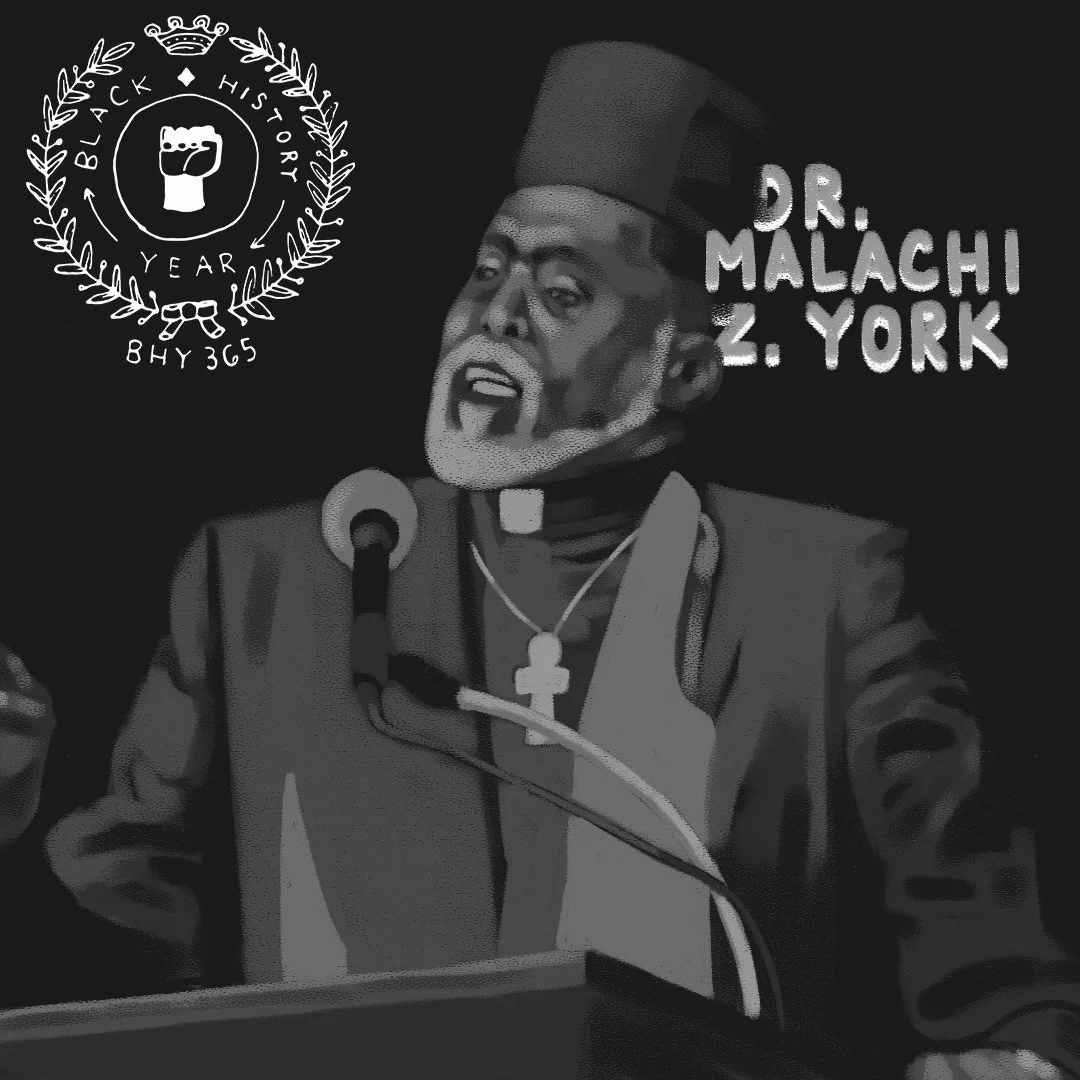
Black History 365 | # 243 Dr. Malachi Z. York

July 14, 2025

Dr. Malachi Z. York is a name that most of mainstream society is unfamiliar with. He is (or was) a very influential figure in Brooklyn, New York who relocated to Putnam County, Georgia. Initially he formed groups in Brooklyn and was known as someone who elevated the minds, beliefs, and practices of the people in the community. More recently, he is being categorized as a cult leader and his currently in prison and is now serving a 135-year sentence on federal child-molestation charges. M’pa konnen man.

Tags Black History 365
Comment
← Newer Posts Older Posts →

Latest Posts

Featured
Jan 27, 2026
Black History 365 | # 292 Julia Jacobs
Jan 27, 2026
Jan 27, 2026
Jan 21, 2026
Black History 365 | # 291 Winnie Mandela
Jan 21, 2026
Jan 21, 2026
Jan 14, 2026
Black History 365 | # 290 Nelson Mandela
Jan 14, 2026
Jan 14, 2026
Jan 11, 2026
Black History 365 | # 289 The Black Liberation Army
Jan 11, 2026
Jan 11, 2026
Jan 7, 2026
Black History 365 | # 288 Wallace Fard Muhammad
Jan 7, 2026
Jan 7, 2026
Dec 21, 2025
Black History 365 | # 287 Vernon Dahmer
Dec 21, 2025
Dec 21, 2025
Dec 17, 2025
Black History 365 | # 286 Isaac Woodard
Dec 17, 2025
Dec 17, 2025
Dec 11, 2025
Black History 365 | # 285 Marion Stokes
Dec 11, 2025
Dec 11, 2025
Dec 10, 2025
Black History 365 | # 284 Maulana Ron Karenga
Dec 10, 2025
Dec 10, 2025
Dec 9, 2025
Black History 365 | # 283 Louise Little
Dec 9, 2025
Dec 9, 2025