

Phillis Wheatley Peters was one of the best-known poets in pre-19th century America. Educated and enslaved in the household of a well-off white man John Wheatley played a part in indoctrinating her with the English language. Wheatley’s work however, was amazing and was the abolitionists’ illustrative testimony that blacks could be both artistic and intellectual. In hindsight we know her precociousness to not be as much as an anomaly as it may have seemed at the time. Through her works she became a household name and her works were a catalyst for the initial literary antislavery movement. Phillis Wheatley was stolen from Senegal/Gambia, West Africa, when she was about seven years old. By the time she was 18, Wheatley had gathered a collection of 28 poems for which she, with the help of Mrs. Wheatley, ran advertisements for subscribers in Boston newspapers in February 1772. Enslavers and abolitionists both read her work; the former to convince the enslaved population to convert, the latter as proof of the intellectual abilities of people of color. Although she supported the American Revolution, she believed that slavery was the issue that prevented the colonists from achieving true heroism. She wrote several letters to ministers and others on liberty and freedom. During the peak of her writing career, she wrote a well-received poem praising the appointment of George Washington as the commander of the Continental Army. In 1778, Wheatley married John Peters, a free Black man from Boston with whom she had three children, though none survived. Efforts to publish a second book of poems failed. To support her family, she worked as a maid in a boardinghouse while continuing to write poetry. Wheatley lived until December 5th, 1784. Wheatley's poems continue to be studied by scholars to this day, and many institutions have honored her legacy, such as the Phyllis Wheatley YWCA in Washington, DC.
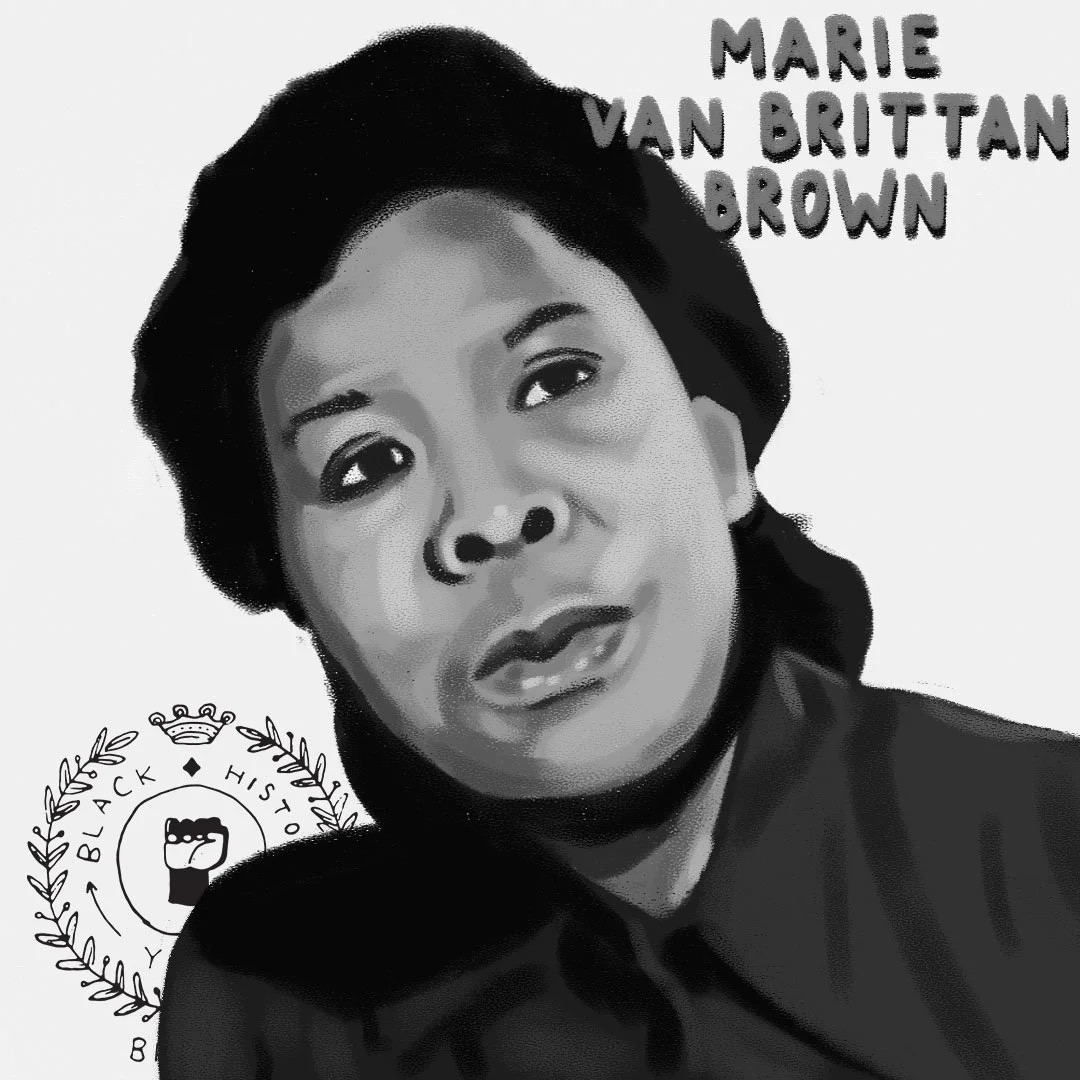
Black History 365 | # 271 Marie Van Brittan Brown
A New York native Marie Van Brittan Brown was born in Jamaica Queens for her whole life, passing on February 2nd, 1999 she was 76 years old. Most notably, Marie Van Brittan Brown invented the first home security system and her invention is the reason home security systems are still used today. Brown’s security system was the basis for the two-way communication and surveillance features of modern security. Her original invention was comprised of peepholes, a camera, monitors, and a two-way microphone. The final element was an alarm button that could be pressed to contact the police immediately. In 1969, Brown and her husband received a patent for the invention under the U.S. Patent number 3,482,037. Her invention was recognized in The New York Times and she received an award from the National Scientists Committee for her work. Men anpil chay pa lou.

Black History 365 | # 270 The Origin Of The Term "Superpredator"
John DiIulio is the person who coined the term “superpredator.” In 1995 DiIulio predicted that a wave of teenagers driven by "moral poverty" numbering in the tens of thousands would soon be on the streets committing violent crime. These "hardened, remorseless juveniles" were framed in the article as a pressing "demographic crime bomb." DiIulio's narrative used racist tropes to further stoke fear — broadly attributing "moral poverty" to "Black inner-city neighborhoods" and families and specifically and repeatedly calling attention to gang violence and "predatory street criminals" among "Black urban youth." Five years later, DiIulio renounced the superpredator theory, apologizing for its unintended consequences. While Dilulio predicted that juvenile crime would increase, it instead dropped by more than half. Conceding that he made a mistake, Dilulio regretted that he could not “put the brakes on the super-predator theory” before it took on a life of its own. DiIulio warned that by the year 2000 an additional 30,000 young “murderers, rapists, and muggers” would be roaming America’s streets, sowing mayhem. “They place zero value on the lives of their victims, whom they reflexively dehumanize as just so much worthless ‘white trash,’" he wrote. The “superpredator” theory, besides being a racist trope, was not borne out in crime statistics. Juvenile arrests for murder — and juvenile crime generally — had already started falling when DiIulio’s article was published. By 2000, when tens of thousands more children were supposed to be out there mugging and killing, juvenile murder arrests had fallen by two-thirds. BLAOW! HOLD THAT.

Black History 365 | # 269 Barbara Jordan
Barbara Jordan praise is due. Most notably, in 1972, Jordan became the first African American woman to be elected to Congress from the South since 1898. In addition, she was the first black woman ever elected to Congress from the South, the first black woman in America to preside over a legislative body, the first black chief executive in the nation, and the first woman and the first Black keynote speaker at a Democratic National Convention. During her career, Jordan sought legislative remedies to expand the reach of the Civil Rights Act of 1964 and Voting Rights Act of 1965. “The momentum of the 1960’s has run out,” Jordan declared. “Congress will be called upon to defend progress already made rather than undertake new initiatives. Although she was very quiet about her private life, many historians suggest that her caregiver Nancy Earl, was also her life partner. Earl was an educational psychologist that traveled with Jordan for nearly thirty years. On January 17, 1996, Barbara Jordan died from pneumonia, a complication of leukemia.

Black History 365 | # 268 Septima Poinsette Clark
Shoutout to Septima Poinsette Clark. She is an American educator and civil rights advocate who studied under W.E.B. Du Bois at Atlanta University before eventually earning her BA (1942) from Benedict College in Columbia, and her MA (1946) from Virginia’s Hampton Institute. She was also active in several social and civic organizations, among them the National Association for the Advancement of Colored People (NAACP), with whom she campaigned, along with attorney Thurgood Marshall, for equal pay for Black teachers in Columbia. In an effort to diminish the effectiveness of the NAACP, the South Carolina state legislature banned state employees from being associated with civil rights organizations, and in 1956 Clark left South Carolina for a job in Tennessee, refusing to withdraw from the NAACP. After Clark retired from active work in 1970, she fought for and won reinstatement of the teaching pension and back pay that had been canceled when she was dismissed in 1956. She later served two terms on the Charleston County School Board. In 1979 Clark received a Living Legacy Award from U.S. President Jimmy Carter. She died December 15, 1987, Johns Island, South Carolina of natural causes. Rest in peace. Respect to her legendary career.