
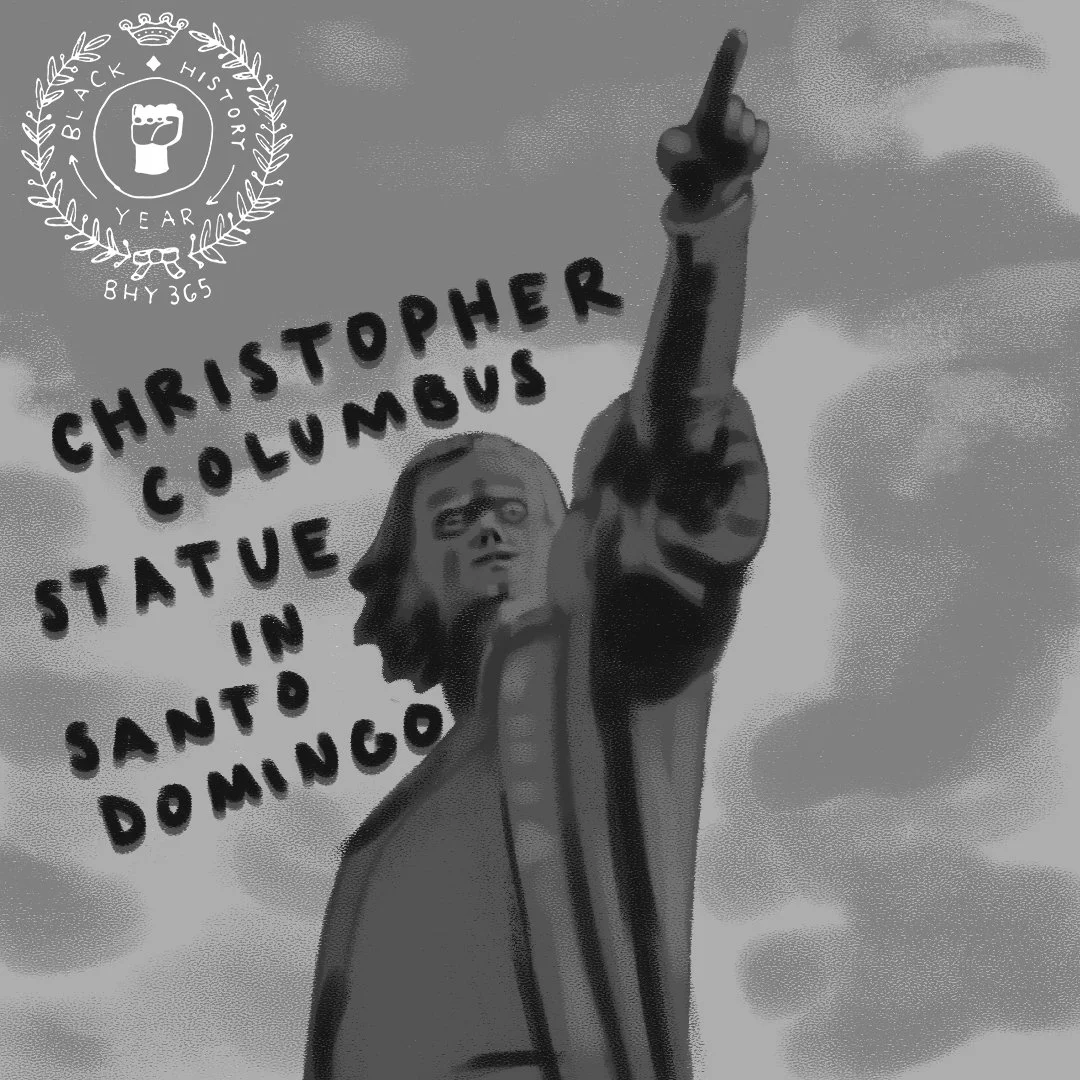
According to The Orlando Sentinel, Dominicans make no bones about Christopher Columbus. His statue is a feature in a Jack Cana tour. The website states “The Christopher Columbus monument is located in the colonial city of Santo Domingo. Columbus Park is the exact spot where the statue is erected, surrounded by other very important historical buildings such as the Cathedral of Our Lady of the Incarnation, considered the first cathedral in America.”

Black History 365 | # 146 Rafael Trujillo
General Rafael Leonidas Trujillo came to power in 1930 and established an oppressive dictatorship in the Dominican Republic that lasted until his assassination in 1961. El Jefe (The Chief), as Trujillo was called, used his secret police to make arrests at will. The most infamous moment during his presidency was the massacre of thousands of Haitian citizens in 1937. Trujillo’s soldiers murdered Haitians working as sugar cane cutters or living in Dominican territory. Estimates of the men, women and children killed range from 13,000 to 20,000. It is a dark part of history that hasn’t much helped uniting the people on the Island of Hispaniola. Trujillo was also of part-Haitian descent.

Black History 365 | # 139 Ralph Ellison

Black History 365 | # 138 Carrie Mae Weems
Carrie Mae Weems is an influential African American artist most renowned for her visually compelling photography that combines text and audio to capture the particularities of past and contemporary African American life. Throughout her three-decade career, Weems has been an artist in residence and visiting professor at numerous locations. She has been recognized by several institutions and awarded multiple honorary degrees. In January of 2014, a 30-year retrospective of Weems works was featured at the Solomon R. Guggenheim Museum in New York, marking the first solo exhibition featured at the museum by an African American woman. Her works have also been featured in The Frist Center for Visual Arts, The Metropolitan Museum of Art, The Museum of Fine Arts in Houston, The Cleveland Museum of Art, The Tate Museum in London, The Minneapolis Museum of Art, and the Centro Andaluz de Arte Contemporaneo in Spain. Her list of awards includes The Tiffany Award, The Anonymous Was A Woman Award, and The National Endowment of the Arts, and the BET Honors Visual Artist Award. Weems was also presented with one of the first U.S. State Department Medal of Arts Awards in 2012. Weems is concerned with the historical complexities of race, gender, class, and identity, offering a powerful and thought-provoking commentary on social injustice and inequality. And because that we honor and salute her.

Black History 365 | # 137 Dr. Frances Cress Welsing
Dr. Frances Cress Welsing published her first significant work, “The Cress Theory of Color-Confrontation,” as an essay in 1974 while an assistant professor at Howard University. In the controversial essay, Welsing argued that the drive for white supremacy and superiority stems from a pervasive feeling of inadequacy and inferiority. Welsing claimed that “whiteness” was, in fact, a deficiency, evidenced by the inability of whites and other races to produce melanin, which generates skin color. In short, white people in America could not cohabit peacefully with their Black peers, according to Welsing, because of a deep-seated jealousy of people with melanin and their embrace of racial supremacy to accommodate these feelings. The essay was controversial and, according to Welsing, prevented her from not only gaining tenure at Howard but, in fact, losing her teaching post. In 1991 she authored The Isis Papers: The Keys to the Colors, a central and core argument for the African origins of civilization through the highlighting of the achievements of African/Egyptian pioneers in the areas of architecture, science, philosophy, and humanism. These origins are often re-colored and re-stated through Eurocentric fabrications, including the fact that some scholars have even dismissed ‘The Papers’ as not having made a direct link between racism and oppression, or even resistance to oppression. Despite the controversy surrounding her, Welsing was praised in the Los Angeles Times for being “the first scientist to psychoanalyze white racism” in the history of Western psychiatry, rather than focusing on the victims of racism. Aside from her published racial and social theories, Welsing was an advocate for a strong African American family unit. She advised black men and women to delay having children until their thirties and instead take the time to thoroughly educate themselves so as to rear the next generation of high-functioning and disciplined black Americans who could challenge white supremacy. Frances Cress Welsing died in Washington, D.C., on January 2, 2016, after being hospitalized for a stroke. She was eighty years old.