
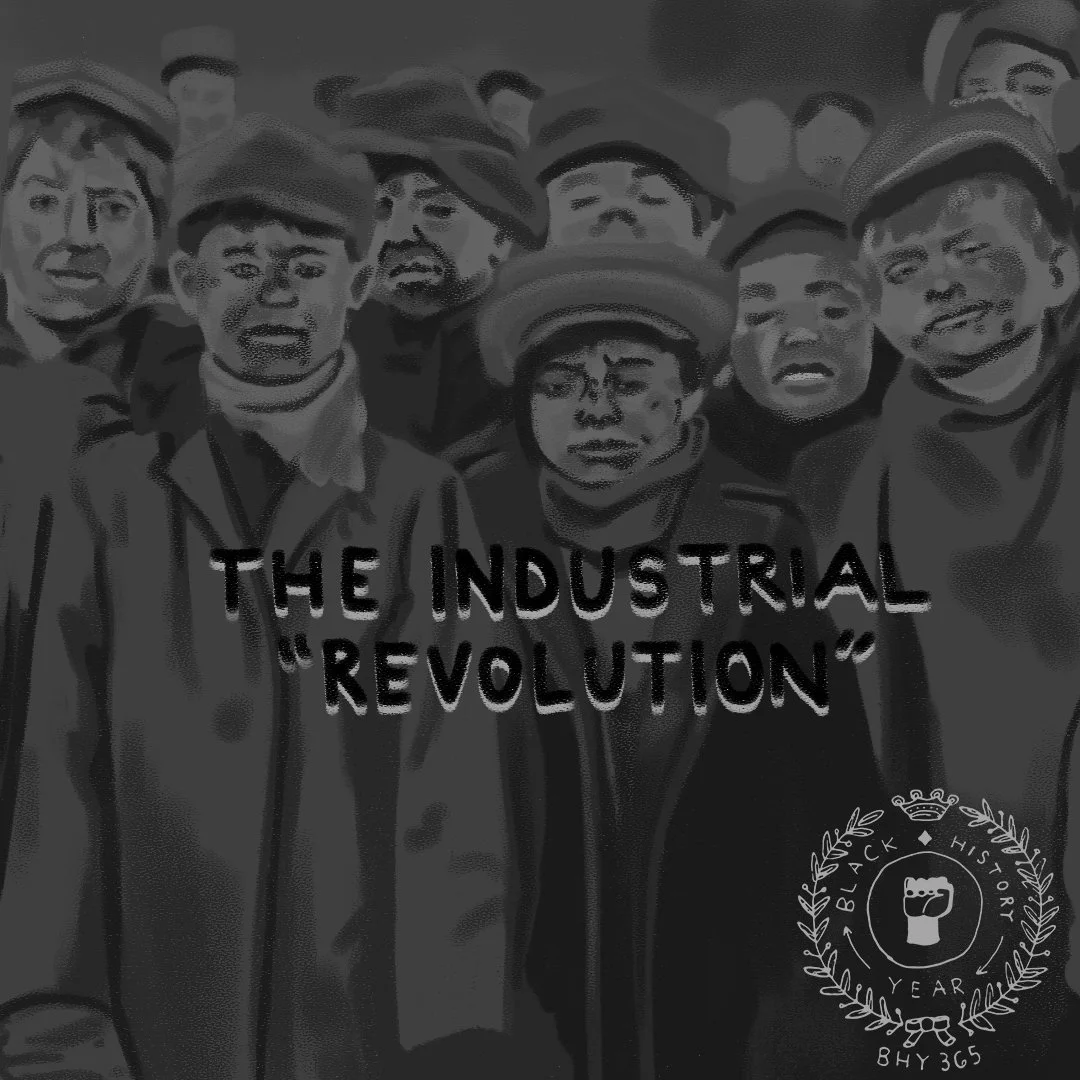
Let’s learn about the Industrial Revolution. You may know it as the radical change in technological innovations allowing us to make goods and materials faster leading to the major shift in economic growth for the United States of America. And sure, it’s partially that. But what was the nucleus for that radical change?…slavery. Yes slavery. The US changing from being a colonial, agricultural economy to now being the largest industrial power in the world is because of slavery. The modern, efficient, and dynamic descriptions of economic growth that we often are told about the Industrial Revolution are the same way many folks described slavery in its time. It’s modern, it’s efficient, and dynamic for economic growth. Get outta here. The mindset that leads to an Industrial Revolution is the same mindset that expands west and massacres the Native people in the name of God. The Industrial Revolution comes from greed and an insatiable appetite for more with little to no consideration for anything other than the acquirement of more. The Industrial Revolution legitimizes and makes the academic argument for greed. It really is misguided patriotism at best, and internalized racism at worst to view it as an economic boom. Which it was…an economic boom. Again, get outta here. More than half of the nation’s exports in the first six decades of the 19th century consisted of raw cotton, almost all of it grown by slaves. Cotton was the No. 1 export from the US, which was largely an export-driven economy as it was modernizing and shifting into industrialization. And the slavery economy of the US South was deeply tied financially to the North, to Britain, to the point that we can say that people who were buying financial products in these other places were in effect owning slaves and were certainly extracting money from the labor of enslaved people. Forced labor created the cornerstone commodity that supplied Northern textile mills and fueled America's early commercial, financial, and manufacturing dominance. Slavery was the first big business in America y’all. The fact that is a factual sentence is proof of the lack of conscious and surplus of greed in the name of economic growth. Slavery was the first big business in America. Remember, how things starts are inevitably how they end, but we know that this thing is rooted in more. We are STILL living in the Industrial Revolution. There’s been one, two, three Industrial Revolutions. The tools, the technology, the players have changed, but the mentality hasn’t. It hasn’t ended, and so, the cruelty continues. In more recent history and now, it’s the digital revolution. Our electronic production is doing them so dirty in Vietnam, in Ghana, in Nigeria. The workplaces that again, were built off slavery were dangerous for the workers. They were hazardous. Child labor was cheaper and thus deemed acceptable. Burning coal, burning fossil fuels causing air pollution. Climate change as early as 1830 came as a result of the Industrial Revolution. Have you heard of the Prison Industrial Complex? Incarcerated workers in the U.S. generate at least $11 billion annually in goods and services. However, they are typically paid an average of just $0.13 to $0.52 per hour, with some states (like Texas, Florida, and Georgia) paying nothing at all for regular prison maintenance and field labor. Who is disproportionately incarcerated? Black people. Latino people too. So, when you think of the Industrial Revolution think more, bigger, and better for the economy. Artificial Intelligence is depleting the earth’s supply of water…
Black History 365 | # 295 The Transatlantic Slave Trade
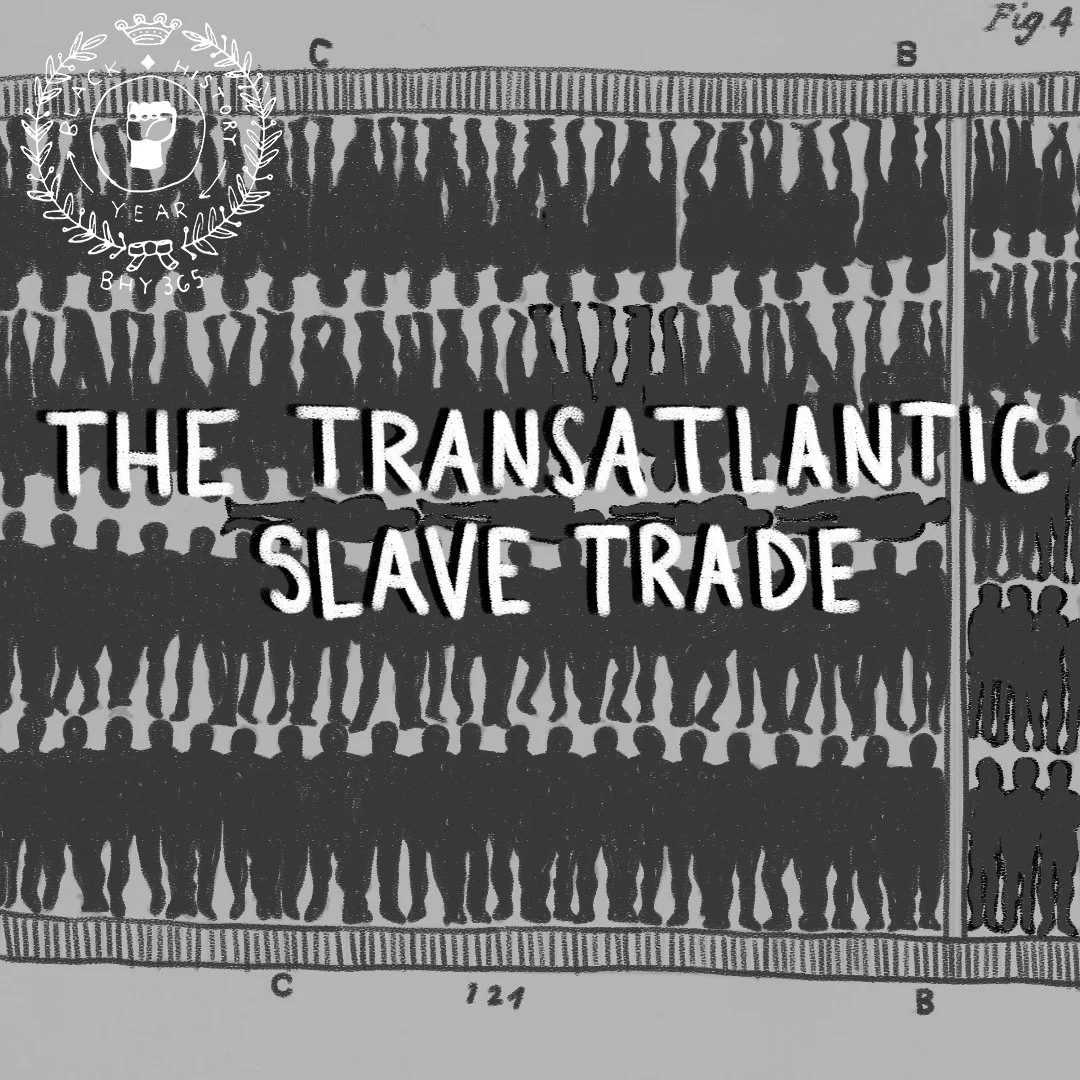
So check this out. The enslavement of people has been a part of human history for centuries. Slavery and human bondage has taken many forms, including enslaving people as prisoners of war or due to their beliefs, but the permanent, hereditary enslavement based on race later adopted in the U.S. was rare before the 15th century. Just recently, on March 25th, 2026 the UN General Assembly declared the transatlantic slave trade, “among the gravest violations of human rights in human history …” The European colonizers ain’t slouches. The most comprehensive shipping records compiled in the Trans-Atlantic Slave Trade Database indicate that approximately 12.5 million Africans were put on these voyages between 1525 and 1866. 10.7 million survived the dreaded Middle Passage, disembarking in North America, the Caribbean and South America. And about 388,000 Africans were shipped directly to North America. The lower deck of a slave ship was divided into separate compartments for men and women, with the men shackled together in pairs and the women left unchained but confined below. The conditions were appalling, with hundreds of people crowded together with little airflow and even less sanitation. Captive Africans suffered from diseases such as dysentery and smallpox, depression and outright despair, the cruelty of captain and crew, and sexual exploitation. As a result, mortality rates averaged above 20 percent for captive Africans in the first decades of the slave trade and about 10 percent by 1800. The possibility of mutiny or revolt resulted in a heavy hand with discipline. Crew and captive cargo were routinely whipped and more extreme forms of violence, including thumbscrews, were used to discipline the Africans. Despite this, Africans did resist. Some committed suicide by jumping overboard or refused to eat, while others organized insurrections, although due to the overwhelming weaponry brought to bear by the crew, few attempts at revolt succeeded. I paraphrase historian Ishakamusa Barashango "Understand that, regardless of the lofty ideas engraved on paper in such documents as the Constitution or Declaration The basic nature of the European American white man remains virtually unchanged" Look around, what do you see?
Black History 365 | # 294 Moor With The Emerald Cluster
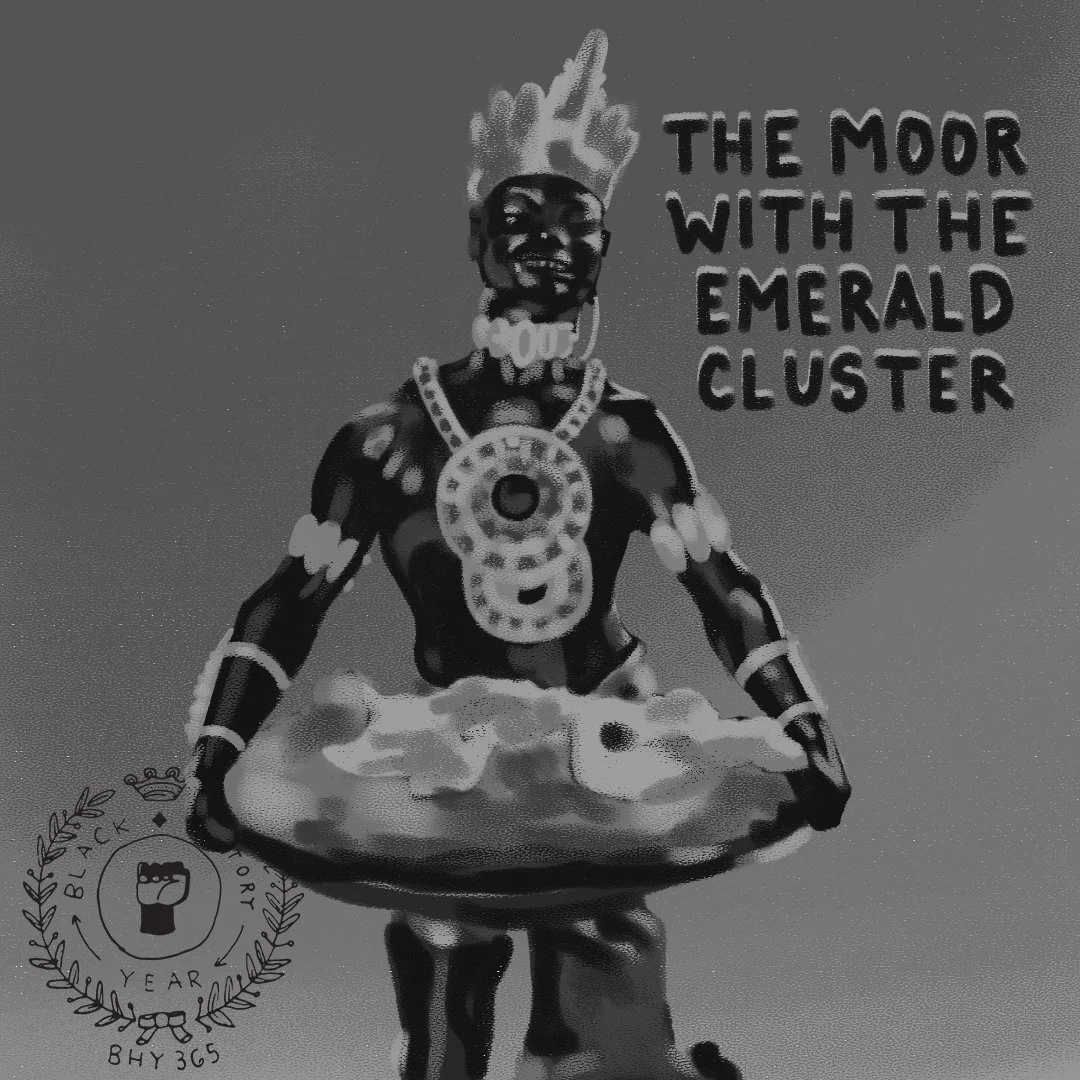
The Moor With The Emerald Cluster (1581). According to Helmut Nickel at The Metropolitan Museum of Art, “The Moor carries a tray of tortoiseshell, containing a matrix of emeralds. This was presented to Elector Augustus (1553-86), the founder of the Dresden Kunstkammer his friend Rudolf (1560), by Emperor II in 1581, when Augustus paid him a visit in Prague, soon after Rudolf's recovery from a serious illness. The emeralds were kept "in a black box lined with crimson velvet," and were catalogued under the section "PreciousStones, Unicorn and Rhinoceros Horns." They were said to have come from the Indies of the West—probably Muzo in Colombia—and had presumably been sent to your Europe by some Spanish conquistador. Elector Augustus treasured them so highly…” art is to be interpreted by the viewer. Marvel at it. This is fly, yes. But dig this — today, many people see Spain as a bastion of Roman Catholicism and the birthplace of the famous Conquistadors who brought this religion to the New World beginning in the 1500s. However, portions of Spain and Portugal were, until shortly before the era of New World settlement, occupied by many Muslims of North African origin. These Moors contributed significantly to culture on the Iberian Peninsula and also affected European culture as a whole. During almost 800 years of Moorish occupation, Spain and Portugal were influenced by new types of architecture, cuisine, and customs. Muslims in Spain also had a significant impact on the Renaissance Era through innovations in science, medicine, and mathematics, which led to widespread improvements in European life. Just some more historical fly sh*t we been on. Your welcome.
Black History 365 | # 293 Elijah Muhammad
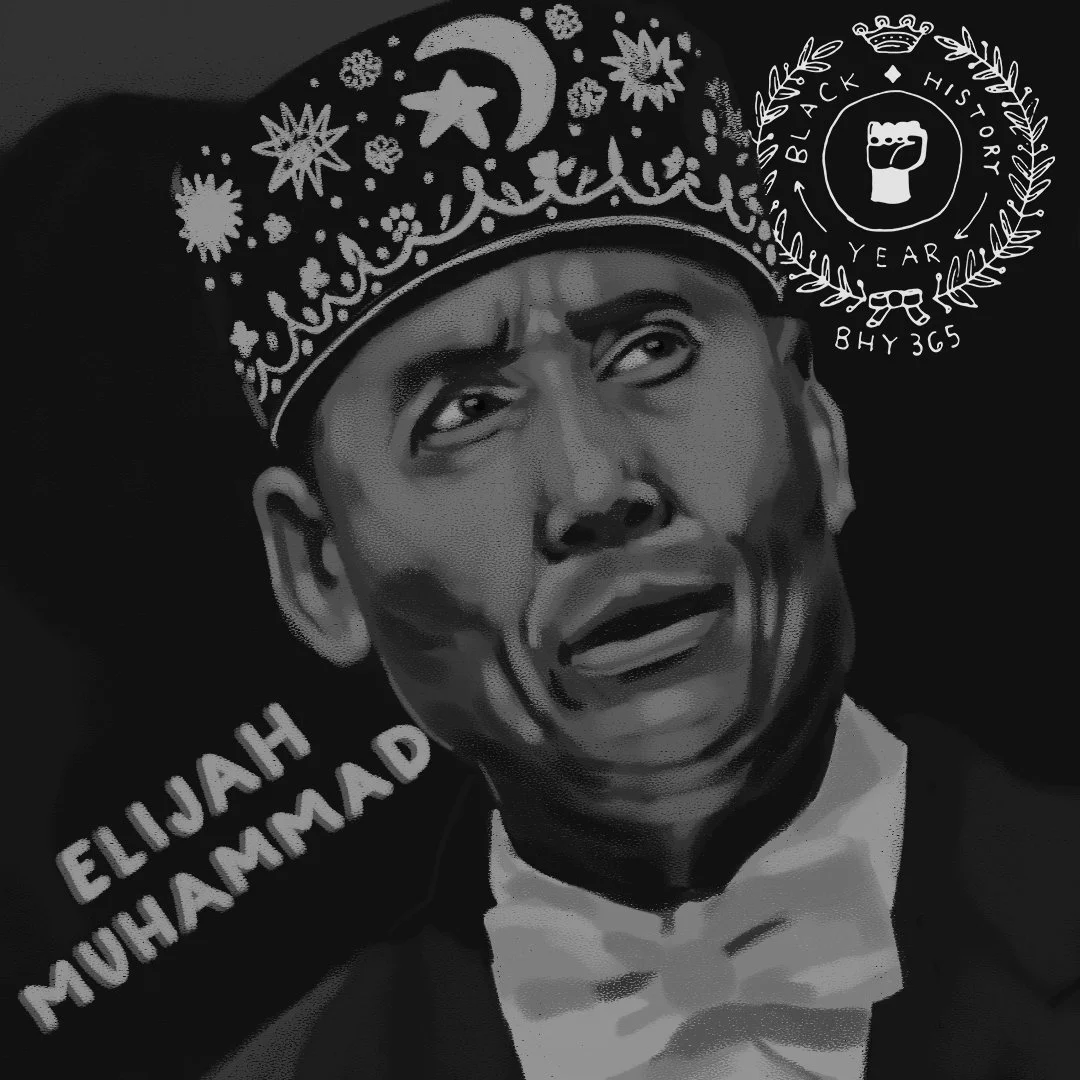
The honorable Elijah Muhammad is aptly known as one of the most significant black leaders of the twentieth century — perhaps one of the most controversial as well. The founder of the Nation of Islam made the bold prediction that, one day, Islam would replace Christianity as the primary faith of black Americans in the 1930s. By 1959, however this same prediction would issue from a leader of the Ku Klux Klan. In a letter to the New York City police commissioner wrote: “If we fail to stop the Muslims now, the sixteen million niggers of America will soon be Muslims, and you will never be able to stop them.” While the remarkable widespread conversion to Islam in the black American community can be attested to the enigmatic Malcolm X. In the final analysis, it was another man, Malcolm X’s mentor, who had the greater impact on establishing Islam among African-Americans. Small in stature, wispy voiced, uncharismatic, and mysterious figure Elijah Muhammad was followed closely by the FBI (as part of the controversial COINTELPRO program) by means of extensive wiretaps and letter-openings. The resulting reports, now available to researchers in all their immensity—the FBI’s papers alone amount to well over a million pages—reveal the most intimate secrets of Elijah Muhammad’s household. Anyone that can enlighten black people en masse will be seen as a threat to the safety of America. In early 1931, the originally named Elijah Poole met Wallace Fard Muhammad and quickly became his enthusiastic disciple. Over the course of their three-year partnership, Fard and Elijah Muhammad also elevated Fard’s own theological status—from Allah’s Messiah to Allah himself—with Muhammad taking over the role of Messenger. The message was felt. Peace to the Nation.
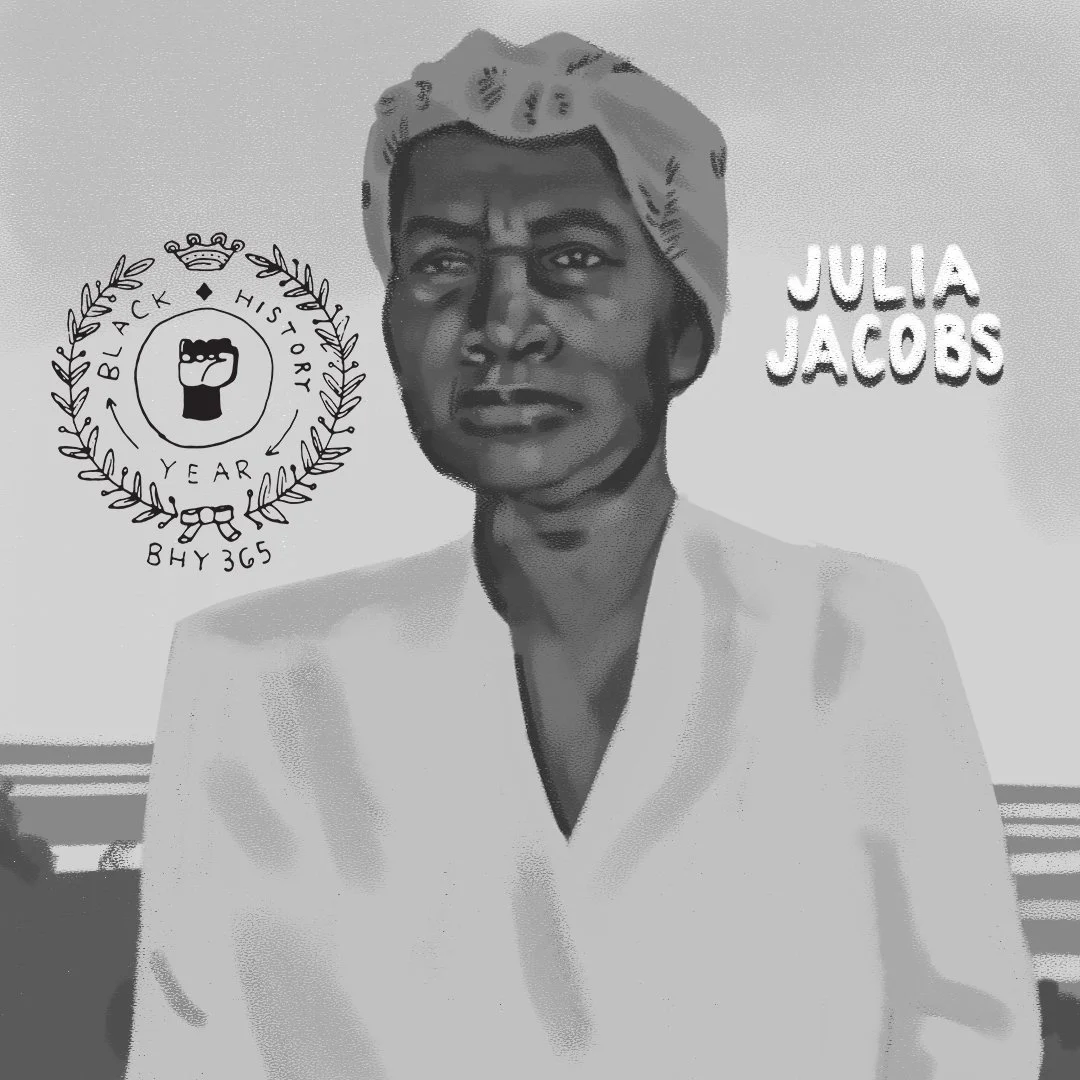
Black History 365 | # 292 Julia Jacobs
Julia Jacobs is the currently accepted story of Blackness in Native American tribes. In 2022, the Suquamish Tribe accepts and honors Black History Month on their https://suquamish.nsn.us/ website. Julia Jacobs was an important culture bearer for the Suquamish Tribe, now located on the Port Madison Indian Reservation, in Washington State. Although Chief Seattle (Sealth) for whom the city of Seattle is named, is the most famous member of the tribe, many of the current members and descendants of the Suquamish Tribe can trace their lineage back to Julia Jacobs. She was born in 1874 aboard a Portuguese ship in the Puget Sound Region to an enslaved woman. Her mother died during Julia’s birth and her father, possibly a cook on board, could not keep her. The last chief of the Suquamish Tribe, Chief Jacob Wahalchu, and his wife, Mary, adopted the baby and raised her as their own. Julia Jacobs was taught tribal traditions from her parents, Jacob and Mary. She was fluent in Lushootseed, the language of the Suquamish Tribe and many other Puget Sound tribes. She attended the Tulalip Indian Boarding School near Priest Point, Washington alongside other Native American children in the area, where she, like the others enrolled, was unable to practice her Suquamish traditions. Despite the contributions Julia Jacobs made to the continuation of Suquamish culture, through an era of assimilation, she is not recognized on the tribal rolls of the Suquamish Tribe. Nonetheless, she played a key role in preserving the culture. Julia Jacobs passed away in 1960 at the age of 86 and was laid to rest in Suquamish, next to her father, Jacob Wahalchu, and her mother, Mary Wahalchu. She has since been joined by her granddaughter, Evelynne Gemmell. Julia Jacobs showcases the diversity of tribal histories and identities particularly among the Coast Salish people.